Key Takeaways
- AI-powered marketing agencies deliver 25–45% higher ROI than traditional agencies when working with structured data.
- Campaign launch timelines compress from 2–6 weeks to same-day with AI-driven workflows.
- AI agencies reduce marketing costs by 25–35% through automation of creative testing, segmentation, and optimization.
- Traditional agencies still excel at emotional storytelling and cultural nuance — but AI is closing the gap fast.
- The average traditional agency costs $15,000–$50,000/month vs. AI platforms starting at $750/month.
The marketing industry is undergoing its most significant transformation since the advent of digital advertising. In 2026, U.S. advertising spend is forecast to reach $414.7 billion, according to Dentsu — but behind that growth lies a fundamental shift in how campaigns are planned, executed, and optimized. The question is no longer whether AI will reshape marketing. It already has. The real question is whether your business is positioned to benefit from it.
For decades, businesses have relied on traditional marketing agencies — teams of strategists, designers, copywriters, and media buyers who craft campaigns through manual research, creative intuition, and periodic reporting cycles. This model worked when the digital landscape was simpler. But today, with consumers interacting across dozens of touchpoints, generating millions of data signals daily, and expecting hyper-personalized experiences, the traditional agency model is struggling to keep pace.
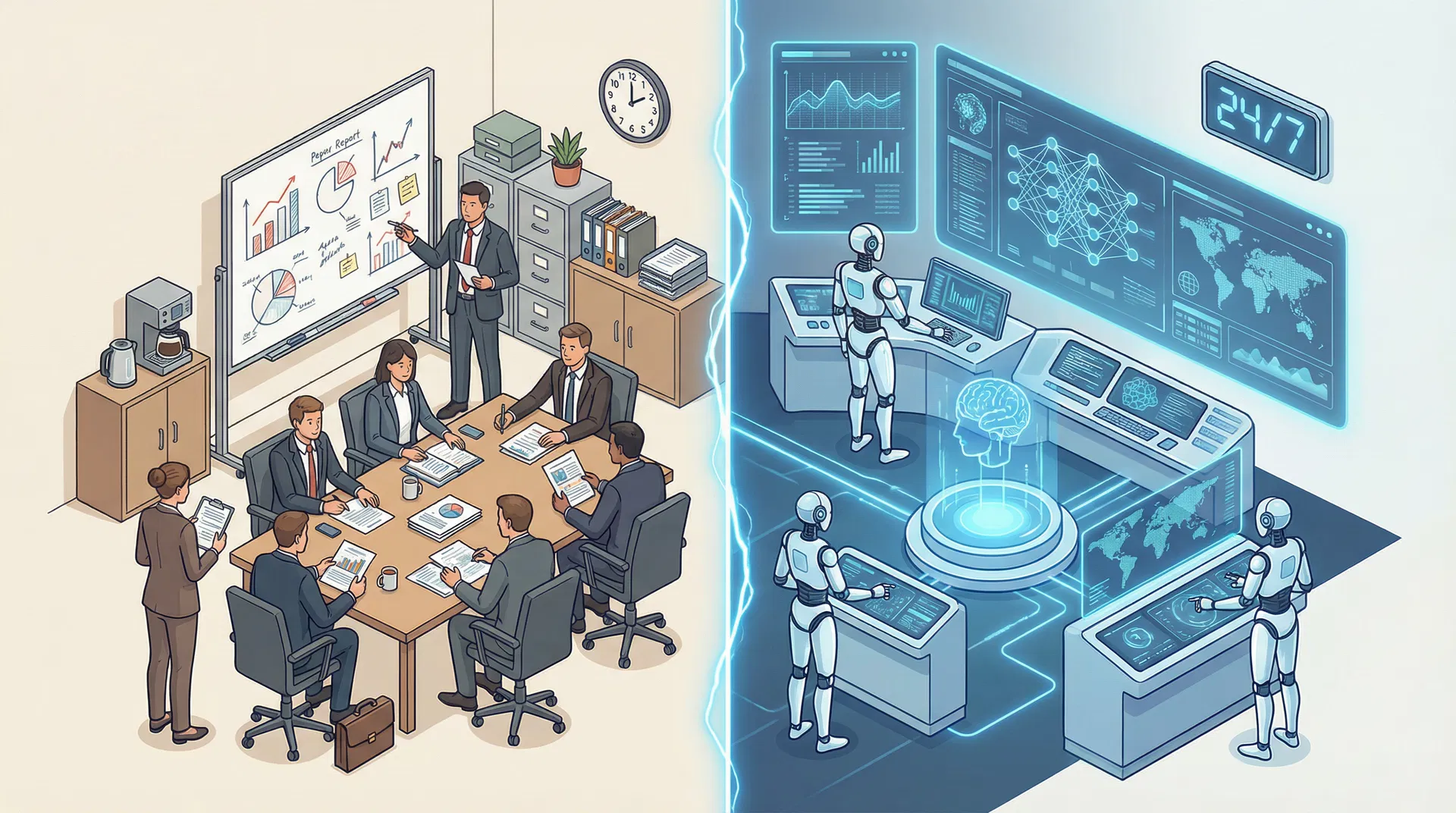
Enter AI-powered marketing platforms like VybeMedia. These systems deploy intelligent AI agents that work around the clock — analyzing data, optimizing bids, personalizing content, and generating leads while traditional agencies are still scheduling their Monday morning standup. This article examines the data, the economics, and the strategic implications of choosing between these two fundamentally different approaches to growth.
What Is AI Marketing, Exactly?
AI marketing refers to the use of artificial intelligence technologies — including machine learning, natural language processing, predictive analytics, and computer vision — to automate and optimize marketing processes at a scale impossible for human teams alone. Unlike simple marketing automation tools that follow pre-set rules, AI marketing systems learn continuously from data, adapt strategies in real time, and make autonomous decisions to improve campaign performance.
At VybeMedia, this takes the form of specialized AI agents — each designed for a specific marketing function. The Lead Gen agent identifies and engages prospects across channels. The Ad Optimization agent manages bidding strategies and creative testing across Google, Meta, and programmatic networks. The SEO agent monitors rankings, builds citations, and optimizes content for both traditional search engines and AI answer engines. The Email agent crafts personalized sequences that adapt based on recipient behavior. And the Data & Intel agent synthesizes all performance data into actionable insights.
The critical difference from a traditional agency is not just the technology — it is the operating model. Traditional agencies operate on human schedules, billing cycles, and creative timelines. AI agents operate continuously, processing thousands of data points per second and making micro-adjustments that compound into significant performance advantages over time.
The Cost Comparison: Where Your Budget Actually Goes
According to a 2026 analysis by BattleBridge, a traditional marketing agency costs between $15,000 and $50,000 per month, depending on scope. Building an equivalent in-house team runs $348,000 to $536,000 annually when accounting for salaries, benefits, tools, and overhead. These costs reflect the reality of human-powered marketing: strategists, account managers, designers, copywriters, media buyers, and analysts all need to be compensated for their time.
AI-powered marketing platforms fundamentally restructure this cost equation. VybeMedia's plans start at $750 per month for the Starter Visibility tier and scale to $3,000 per month for the Market Leader package. Even the most comprehensive custom enterprise plans begin at $5,000 per month — still a fraction of what a mid-tier traditional agency charges for comparable scope.
Traditional Agency
$15K–$50K
per month
In-House Team
$29K–$45K
per month (annualized)
AI Platform (VybeMedia)
$750–$5K
per month
The savings are not merely about lower fees. AI platforms eliminate the overhead of project management layers, revision cycles, and the coordination tax that comes with managing multiple human specialists. When an AI agent optimizes a Google Ads campaign, it does not need to schedule a meeting, prepare a deck, or wait for approval on bid adjustments. It simply executes — thousands of times per day — based on real-time performance data.
Performance Metrics: The Numbers Don't Lie
The performance gap between AI-powered and traditional marketing is widening. According to industry benchmarks compiled by RZLT, AI-powered marketing agencies deliver 25–45% higher ROI than traditional agencies when working with well-structured data. A 2024 McKinsey report found that organizations adopting AI-powered personalization strategies reported 20–30% higher marketing ROI compared to traditional methods, with measurable increases in both sales conversion rates and customer engagement.
These are not marginal improvements. For a business spending $10,000 per month on marketing, a 30% ROI improvement translates to an additional $36,000 in annual revenue — often more than the entire cost of the AI platform itself. Research from Aprimo shows that AI-powered content delivery is 84% faster than traditional methods, while SQ Magazine reports that businesses using AI across at least three core marketing functions see a 32% increase in ROI on average compared to 2024 baselines.
The compounding nature of AI optimization is what makes these numbers particularly significant. Traditional agencies optimize in discrete cycles — monthly reports, quarterly strategy reviews, annual planning sessions. AI systems optimize continuously, making hundreds of micro-adjustments daily. Over the course of a year, this continuous optimization creates a performance gap that widens exponentially.
Speed & Efficiency: From Weeks to Hours
In traditional agency workflows, launching a new campaign involves a well-documented sequence: discovery call, strategy development, creative brief, design rounds, copy revisions, client approval, media planning, trafficking, and finally, launch. This process typically takes two to six weeks — and that is when things go smoothly. Add stakeholder disagreements, creative revisions, or compliance reviews, and timelines can stretch to months.
AI-powered platforms compress this timeline dramatically. VybeMedia's Growth Plan Builder allows businesses to answer a few strategic questions, receive an AI-generated marketing plan with channel recommendations and budget allocation, and launch campaigns within 24 to 48 hours. The AI agents handle creative generation, audience targeting, bid strategy, and tracking setup simultaneously — tasks that would require coordination across four or five specialists in a traditional agency.
Campaign Launch Timeline
Speed matters beyond convenience. In competitive markets, the ability to respond to trends, competitor moves, or seasonal opportunities within hours rather than weeks can be the difference between capturing market share and watching it go to a faster competitor. AI platforms turn marketing from a planning-heavy discipline into a responsive, real-time operation.
Personalization at Scale: The AI Advantage
Traditional agencies typically segment audiences into three to five broad personas — "young professionals," "budget-conscious families," "enterprise decision-makers." Each persona gets a tailored message, but the personalization stops there. Creating more granular segments requires more creative assets, more copywriting, more design work, and more project management — all of which drive costs up linearly.
AI fundamentally changes this equation. Machine learning algorithms can identify and target thousands of micro-segments simultaneously, adjusting messaging, creative elements, and offers based on individual behavioral signals. A user who visited your pricing page three times but never converted gets a different message than someone who downloaded a whitepaper last week. A prospect in Miami sees different imagery than one in Minneapolis. A returning customer receives a loyalty-focused offer while a new visitor gets an educational introduction.
Starbucks demonstrated the power of this approach with their Deep Brew AI platform, which delivered a 30% ROI improvement within 18 months and increased customer engagement by 15%. The system personalizes offers, recommendations, and communications for millions of individual customers — a task that would require an army of human marketers to replicate manually. For small and mid-sized businesses, AI platforms like VybeMedia bring this same capability within reach at a fraction of the cost.
Where Traditional Agencies Still Win
Intellectual honesty requires acknowledging that AI has not yet mastered every dimension of marketing. Traditional agencies retain meaningful advantages in several areas that matter for certain types of campaigns and brands.
Emotional Storytelling
Crafting narratives that resonate on a deeply human level — the kind of storytelling that makes people laugh, cry, or feel genuinely connected to a brand — remains a distinctly human strength. AI can generate competent copy, but the spark of creative genius that produces iconic campaigns still comes from human minds working in collaborative, often messy, creative processes.
Cultural Nuance & Sensitivity
Marketing that navigates cultural contexts, social movements, or sensitive topics requires a level of judgment and empathy that AI systems are still developing. A human strategist understands the difference between a bold statement and an offensive one in ways that algorithms cannot yet reliably replicate.
Complex Stakeholder Management
Large organizations with multiple decision-makers, compliance requirements, and political dynamics benefit from the relationship management skills that experienced agency professionals bring. Navigating boardroom politics, managing expectations across departments, and building consensus around creative direction are inherently human tasks.
However, it is worth noting that these advantages are most relevant for large-scale brand campaigns, not for the performance marketing, lead generation, and growth-focused activities where most small and mid-sized businesses allocate their budgets. For the majority of businesses focused on generating leads, driving conversions, and maximizing ROI, AI platforms offer a compelling advantage.
Head-to-Head: The Complete Comparison
The following table summarizes the key differences across the metrics that matter most for business growth. Data is compiled from McKinsey, BattleBridge, Aprimo, RZLT, and VybeMedia's own performance benchmarks.
| Metric | Traditional Agency | AI Platform | Edge |
|---|---|---|---|
| Average Monthly Cost | $15,000 – $50,000 | $750 – $5,000 | AI |
| Campaign Launch Time | 2 – 6 weeks | Same day – 3 days | AI |
| ROI Improvement | Baseline | 25 – 45% higher | AI |
| Personalization Scale | 3 – 5 segments | 1,000+ micro-segments | AI |
| Optimization Cycle | Weekly/Monthly reports | Real-time, 24/7 | AI |
| Cost Per Lead Reduction | Baseline | Up to 62% lower | AI |
| Content Delivery Speed | Days to weeks | 84% faster | AI |
| Emotional Storytelling | Strong | Developing | Trad |
| Cultural Nuance | Strong | Limited | Trad |
| Complex Stakeholder Mgmt | Strong | Limited | Trad |
Sources: McKinsey State of AI Report (2024), BattleBridge Agency Cost Analysis (2026), Aprimo Content Delivery Study, RZLT AI Marketing Benchmarks, SQ Magazine AI Statistics (2026).
Real-World Results: What VybeMedia Clients Experience
The theoretical advantages of AI marketing translate into tangible business outcomes. VybeMedia clients across industries — from local service businesses to e-commerce brands to B2B SaaS companies — consistently report measurable improvements after switching from traditional agencies.
62%
Lower cost per lead compared to previous traditional agency
3.2x
Average increase in qualified leads within first 90 days
24hrs
Average time from onboarding to first campaign launch
24/7
Continuous optimization — no weekends, no holidays, no sick days
These results are not anomalies. They reflect the structural advantages of AI-powered marketing: lower overhead, faster execution, continuous optimization, and data-driven decision-making at a scale that human teams simply cannot match. The 58% of U.S. marketers who now integrate AI into their workflows, according to Adobe's 2026 marketing statistics report, are experiencing similar gains across industries.
The Future: AEO, Answer Engines, and the Next Frontier
The marketing landscape is evolving beyond traditional SEO into a new paradigm: Answer Engine Optimization (AEO). As consumers increasingly turn to AI assistants like ChatGPT, Perplexity, Google AI Overviews, and Claude for answers, businesses need to optimize not just for search engine rankings but for AI-generated responses. This is a domain where AI marketing platforms have a natural advantage — they understand how AI systems process and prioritize information because they are built on the same foundational technologies.
VybeMedia's approach to AEO includes structured data optimization, entity-based content strategies, and continuous monitoring of how AI systems reference and recommend businesses. Traditional agencies are only beginning to understand this space, while AI-native platforms have been building for it from the ground up.
The convergence of AI marketing, AEO, and predictive analytics points toward a future where marketing becomes increasingly autonomous, personalized, and performance-driven. Businesses that adopt AI-powered platforms today are not just saving money — they are building a competitive moat that will widen as AI capabilities continue to advance. The gap between AI-optimized businesses and those still relying on traditional methods will only grow larger.
Conclusion: The Verdict Is Clear
The data tells a compelling story. AI-powered marketing platforms deliver higher ROI, lower costs, faster execution, and more granular personalization than traditional agencies across nearly every measurable dimension. For the vast majority of businesses — particularly small and mid-sized companies focused on lead generation and growth — the economic case for AI marketing is overwhelming.
Traditional agencies retain advantages in emotional storytelling, cultural sensitivity, and complex stakeholder management. These strengths matter for large-scale brand campaigns. But for the performance marketing, lead generation, SEO, AEO, and growth-focused activities that drive revenue for most businesses, AI platforms represent a fundamental step forward.
The question is not whether AI marketing will become the standard — it is how quickly your business will make the transition. Every month spent with an overpriced traditional agency is a month of missed optimization, missed leads, and missed growth. The AI agents are ready. They work 24/7. And they are waiting for you to get started.
VybeMedia Research Team
The VybeMedia Research Team publishes data-driven insights on AI marketing, digital advertising, SEO, AEO, and growth strategies. Our analysis combines industry benchmarks, proprietary performance data, and academic research to help businesses make informed decisions about their marketing investments.